


Recently, I received a comment on one of the book communities on Reddit (not the best place for intellectual discourse, I know). Reddit tends to be a left-leaning space, which is all fine and good at times, but there are some opinions that are absolutely worthy of critique.
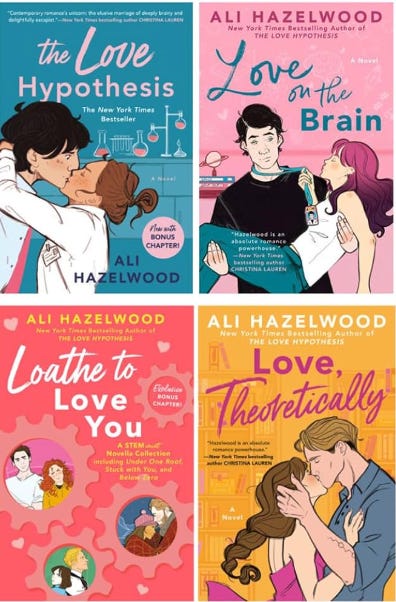
In my case, this commenter told me that it wasn’t a big deal that teenagers were being introduced to graphic erotica nowadays—sex scenes are essentially the norm. Most young adult (YA) books contain smutty, spicy scenes that entice the readers into coming back for more and more. Ali Hazelwood is one such author, whose latest book Deep End is supposed to be a romance that delves into BDSM, introducing this lifestyle to her young, female audience.
Now, let me just say for transparency’s sake that when I was a teenager, I also enjoyed reading my fair share of romantic, smut books. But these were fanfiction works. I would purposely seek these out, wandering my little fifteen-year-old self through countless fanfiction tags on Ao3 that advertised having sex scenes and smut. I’ve grown out of that phase, thankfully, but I understood way back when that I was the one looking for these works. The authors weren’t purposely advertising to teenagers and pre-teens specifically; in fact, I remember a lot of fanfiction authors not wanting to interact with minor-aged fans on these sites at all since they knew that the optics wouldn’t look good, being an erotica author and all.
In today’s day and age, it seems like authors and mainstream publishers have done a complete 180. With the cartoonish covers and the young Booktok influencers eager for their next smutty romance, these erotic books are being advertised and pushed to younger and younger female audiences. And I don’t care if that makes me a hater or a prude or whatever other label people want to put on me.
It isn’t right to market sexually explicit books to teenagers. And people have a right to critique that openly.
“Let People Enjoy Things!1!”
This is one of the most aggravating sentences someone can bring up when talking about this because by saying, “you’re not letting people enjoy things! why can’t women enjoy things!” these people are basically wanting to be immune from critique. Which is laughable and fascinating because all art and media can be critiqued and it shouldn’t be a personal attack when someone wants to discuss the ramifications of doing nothing while teenagers consume hardcore pornographic novels.
It also feels like an attempt to infantilize women all while championing anti-intellectualism. Media analyses should be encouraged, not shunned. But there are people who will genuinely have crash outs if you want to have an engaging discussion on the merits, strengths, and weaknesses of certain literary genres.
They will argue that you’re trying to “guilt them into feeling bad,” that you’re trying to “hinder sex positivity,” that you’re trying to “police people’s thoughts and actions,” or whatever else they want to cry about.
Here’s the thing, though. If someone critiques your favorite books, genres, and/or authors, and you suddenly start to feel guilty about liking these things… shouldn’t that evoke some earnest self-reflection? Why are you feeling guilty if someone points out you read nothing but erotic fiction? There must be something inherently strange about that if the first response is anger and self-defensiveness.
When I was a teenager, I read my fanfiction secretly and I was never broadcasting these interests to the world because, honestly, it was a little embarrassing.
But we’ve seen a shift in recent years. Now, we have young readers openly admitting that they are consuming erotic novels, gobbling up everything that Sarah J. Maas, Ali Hazelwood, Rebecca Yarros has to offer. And once they’re done with these, they are on the hunt for more smutty, spicy books that check off certain trope boxes: enemies to lovers, age gap, forced romance, dubious consent, mafia romances, etc.
From Then to Now
When I was growing up, the idea of a mainstream publisher trying to push erotica to a young audience would have been quite audacious, if not outright condemned. I was reading Harry Potter and The Hunger Games and Divergent. Don’t get me wrong, all of these series contain romance subplots, but by no means did they have explicit sex scenes. I remember the most risqué scene of Harry Potter being the vision of Harry and Hermione kissing and she was supposed to be topless—and that shook little twelve-year-old me.
I can’t even fathom what my reaction would have been to the A Court of Thorns and Roses series at the same age.
And therein lies my main critique with many of the top books we see on the charts nowadays being marketed to young audience. The only reason why people are picking them up is for the sex. Whole novels are built around certain tropes, with graphic sex scenes being a necessity in order for the work to be properly enjoyed by the masses.
That also means young kids are being told to pick these books up, to read them, to enjoy them, to talk about them and recommend them to their friends. And when so many of these books are introducing the topic of kinks, age gap relationships, “alpha males,” and more strange tropes, it’s inevitable that this is going to have an impact on their views on romance, relationships, and sex in general.
Brain Candy
It’s incredibly apparent that these kinds of romance books are not supposed to be complicated, thought-provoking reads. I saw someone describe these as being “brain candy” and I feel like that’s an apt description. They’re fun, they often have beautiful covers, they give nice dopamine hits when all the right tropes are hit and sex scenes are included.
But in a day and age where the average American is reading below a sixth grade level, this feels as if we’re just enabling bad habits. Shouldn’t we be pushing for more complicated reads, books that can’t be summarized with three-to-four popular tropes?
I recently read Chris Whitaker’s All The Colors of the Dark. At the very core of it all, it’s both a mystery/thriller and a romance, but I’d be an actual fool if I tried to summarize this book in a few tropes. Because good literature shouldn’t be dumbed down that easily.
Can we properly summarize any of Dostoevsky’s books in three or four tropes? Or Ernest Hemingway’s? Or Jane Austen’s? How about the Brontë sisters?
Books should challenge us to think, not only about ourselves and our worldview, but of the culture and society at large. Books should be exposing kids to varied life experiences, themes about teenagehood and/or adulthood. Should they really be exposing them to different sexual kinks and questionable romantic situations?
I feel like book publishers at-large should be held more responsible. They’re the ones creating the covers targeting to young kids, they’re the ones pumping out easily-digestible novels that are purely escapism, and they’re the ones seeking out young audiences to consume these books.
I remember when Fifty Shades of Grey came out and it was more appropriately marketed towards adult women for very obvious reasons. In today’s world, a book like that would be shamelessly promoted to a younger demographic all in the guise of “sex positivity” and “let people enjoy things!” Give me a break.
“It isn’t right to market sexually explicit books to teenagers. And people have a right to critique that openly.”
Absolutely could not agree more. While I had mixed feeling as a kid when my mom would read/check books before I read them, I look back and appreciate her efforts on that front to keep me away from things like spicy books as a kid.
I brought my son into a local toy store around Valentine’s Day to look at the stuffed animals. It’s a lovely, large shop and they have a sizeable book section as well. A graphic novel featured prominently on the main Valentine’s Day display—the first table you run into when you enter the store—caught my eye because it seemed out of place in a children’s store. As you say, many of these covers make it quite clear that the content is sexual. Lo and behold, the plot of the book was about a gay male teenager’s effort to get his parents to agree to let him sleepover at his boyfriend’s house so that they can have sex. I asked the employees why they were displaying this book in a toy store. I mean, a book about teens sneaking behind parents’ backs to have sex??? In the midst of tricycles and baby dolls. One younger employee giggled while an older, managerial figure informed me, smugly, that they sell YA books too. I think you’re completely right that this is a disturbing phenomenon, and it doesn’t stop at the publishers. It would seem that many adults—booksellers, librarians, teachers, parents, etc—are complicit in pushing this kind of material. I can’t really fathom why. Apologies for the rantish comment, but this was an eye opening experience to say the least.